Railway
Rail Pads
Rail pads are elastic components installed between the rail and the sleeper, designed to transfer loads while filtering high-frequency forces and reducing stress on track structure. They help reduce vibration and structure-borne noise, protect concrete sleepers against crack development and enhance the long-term durability and performance of railway infrastructure under repeated loads and varying environmental conditions.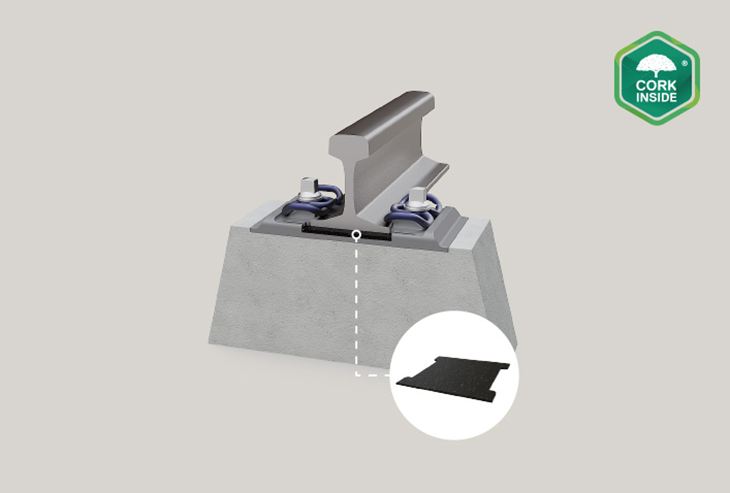
Cork-Rubber Composite Rail Pads
Developed by Amorim Cork Solutions with proven field performance, cork-rubber composite rail pads combine cork´s damping, low density and compressibility with rubber´s strength and elasticity.

Cork-Rubber Rail Pads
- Enhanced resistance to fatigue, temperature variation, and environmental stressors.
- Maintains performance from -20°C to 40°C and across 200-2500 Hz frequency range.

Key Benefits
-

Vibration Insulation
Dissipates dynamic loads and reduces vibration transmission
-

Rolling Noise Reduction
Absorbs and attenuates rolling noise for quieter railway environments
-

Long-Term Durability
Engineered for lasting performance and extended service life
-

Track Stability
Maintains track geometry and performance over time
-

Sustainable & Circular Materials
The incorporation of cork helps reduce material carbon footprint
-

Multi-system Compatibility
Suitable for heavy rail, metro and light rail applications
Product Capabilities
With an extensive reference range (VC91-VC96), Amorim rail solutions are engineered to meet specific project requirements, accommodating varying loads, stiffness demands and operating conditions, while enabling fully customized components with complex geometries through advanced CNC machining and waterjet cutting.


Article
Temperature Effect in Cork-Rubber Rail Pads
Rail pads, the elastic elements placed between the rail and the sleeper, play a critical role in load transfer, vibration control and the long-term performance of railway infrastructure.