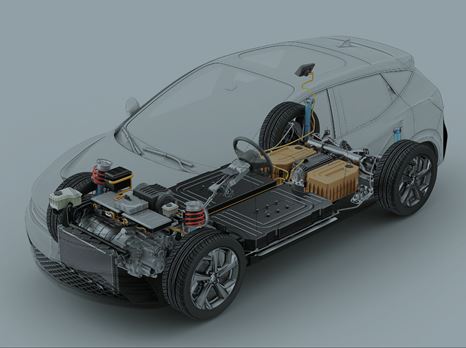
New cork solutions to protect electric vehicle batteries
Cork’s low density with its reduced thermal conductivity and resistance to high temperatures, make it ideal for the development of components for EV batteries.
Battery Fire Protection for EV and Energy Storage Systems
In battery design, bringing multiple critical material properties together in a single solution remains a significant challenge. Components placed between and around cells must help manage heat, respond to mechanical stress, and maintain performance under abnormal conditions such as thermal runaway.
ETP058 is a cork-based engineered material designed to meet these key battery requirements in a single composite solution. By integrating cork granules with a fire-retardant formulation, ETP058 delivers controlled behavior under high temperatures and pressure variations, supporting safer and more resilient battery architectures.
ETP058 was developed with thermal runaway in mind. When a single cell releases heat rapidly, insulating materials play an important role in slowing transfer to adjacent cells.
The composite features a thermal conductivity of 0.054 W/m·K and meets the UL94 V-0 standard for samples thicker than 2 mm. Its performance under flame exposure has also been evaluated at temperatures approaching 1000 ºC, with backside temperature measurements showing a gradual and controlled rise over time.
These results highlight ETP058’s ability to slow heat transfer within the module. Its structure also allows adaptation under compression, helping maintain stability under mechanical loads.
| Property | Standard | Values |
|---|---|---|
| Density (kg/m³) | ASTM F1315 | 330–400 |
| Compressibility at 1,0 MPa (%) | Internal procedure | 18,0 |
| Thermal conductivity (W/mK) | ISO 8301 | 0,054 |
| Flame resistance | UL94 | V0* |
* ≥ 2mm
The data provided in this table represents typical values. This information is not intended to be used as a purchasing specification and does not imply suitability for use in a specific application. Failure to select the proper product may result in either equipments damage or personal injury. Please contact us regarding specific application recommendations. Amorim Cork Solutions expressly disclaims all warranties, including any implied warranties or merchantability or of fitness for a particular purpose. Amorim Cork Solutions is not liable for any indirect special, incidental, consequential, or punitive damages as a result of using the information listed in this tabl. Any of its material specification sheets, its products or any future use or re-use of them by any person or entity.

Cork is a renewable natural raw material harvested from the bark of the cork oak tree, without harming the tree itself. Its microcellular structure provides a distinctive combination of low thermal conductivity, resilience, and low weight.
When integrated into an engineered composite such as ETP058, these natural characteristics help support safer battery designs while contributing to a more responsible material approach.
By leveraging cork’s microcellular structure within a controlled composite formulation, ETP058 provides delayed thermal propagation, mechanical adaptability, and structural integrity during high-temperature events. These characteristics position the material for next-generation battery systems, where safety, performance, and material efficiency must work together.
At the same time, because it is based on cork, a renewable natural raw material, ETP058 supports a more sustainable material approach for electrification. By combining critical battery-material requirements in a single engineered solution, ETP058 reflects the direction of next-generation battery design: safer, more integrated, and more sustainable.
Cork’s low density with its reduced thermal conductivity and resistance to high temperatures, make it ideal for the development of components for EV batteries.
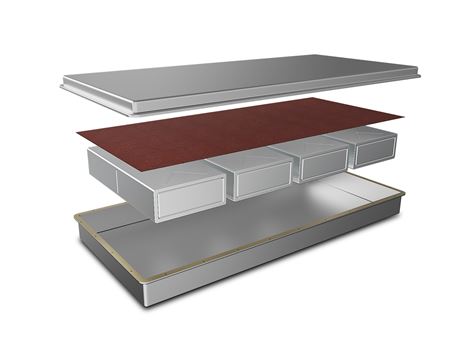
FiberCork combines high performance with sustainability, standing out as the ideal choice for the thermal insulation of electric vehicle batteries.