The Challenge: Protecting What Must Survive
DRACO, short for Destructive Reentry Assessment Container Object, presents an unusual aerospace engineering challenge.
Scheduled for launch in 2027, the ESA mission is designed to deliberately reenter Earth’s atmosphere and break apart, allowing researchers to study what happens to a spacecraft during atmospheric reentry under real flight conditions.
Around 200 sensors and four cameras distributed throughout the spacecraft will record the thermal, mechanical and structural processes involved in its destruction.
But while DRACO itself is designed to break apart, its most important scientific data must survive.
Before the spacecraft is destroyed, critical information collected by its instruments will be transferred to a 40 cm survival capsule. The capsule must withstand the demanding conditions of atmospheric reentry long enough to preserve the data and subsequently transmit it to Earth.
This requirement created a critical need for an effective thermal protection system (TPS).
During atmospheric reentry, a spacecraft is exposed to severe aerothermal conditions. The heat shield provides a protective barrier between this environment and the systems contained within the capsule. For DRACO, this protection has a particularly important purpose: helping protect the capsule carrying the scientific data that gives the mission its value.
The project builds on approximately 15 years of collaboration between Amorim and VKI in aerothermodynamics and thermal protection. P50 had already been selected by VKI for QARMAN – QubeSat for Aerothermodynamic Research and Measurements on AblatioN, an experimental spacecraft developed to collect aerothermodynamic data during atmospheric reentry. DRACO represents the next chapter in this long-standing technical collaboration.
Validating the Thermal Protection System Under Reentry-Like Conditions
Before progressing toward the full-scale capsule, DRACO’s thermal protection system underwent experimental validation at VKI.
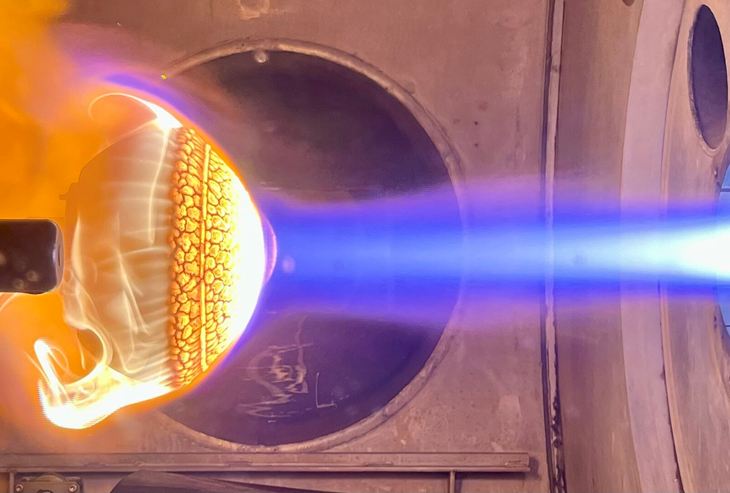
A half-scale version of the capsule was exposed to plasma flows in VKI’s facilities to reproduce key aspects of the aerothermal environment expected during atmospheric reentry. These tests enabled the team to evaluate the heat shield and overall thermal protection design under reentry-like conditions, supporting the development and validation of the final capsule.
The testing phase is particularly relevant to the development of aerospace thermal protection systems, where materials and system architecture must be evaluated against the specific thermal and mechanical requirements of each mission. For DRACO, the plasma testing campaign provided an important step between heat shield development and implementation on the full-scale survival capsule.
From Atmospheric Reentry to Data Recovery
During the mission, DRACO’s sensors and cameras will document the spacecraft as it progressively breaks apart. The most important data will be processed onboard and transferred to the survival capsule protected by the Amorim P50 heat shield.
After passing through the most demanding phase of atmospheric reentry, the capsule will descend to approximately 10 km altitude. Its back shell will then be released and a parachute deployed, slowing the capsule and enabling the collected information to be transmitted via satellite. Before the mission, a full-scale drop test from a balloon at approximately 25 km altitude is planned by the end of 2026 to validate capsule stabilization, parachute deployment and data connection.
Turning Spacecraft Destruction Into Knowledge
The value of DRACO extends beyond the mission itself.
Real-world data on how satellites behave and break apart during atmospheric reentry remains limited. By recording its own destruction, DRACO is expected to provide researchers with valuable information to improve spacecraft reentry models and better understand how different structures and materials behave during atmospheric demise.
This knowledge will support ESA’s work on Design for Demise, an approach that considers spacecraft end-of-life behavior from the design stage and aims to reduce the risks associated with components surviving atmospheric reentry. DRACO also contributes to ESA’s broader Zero Debris approach to reducing the creation of debris in Earth and lunar orbits.
Cork combines low density and low thermal conductivity with characteristics that make it particularly valuable as the basis for engineered thermal protection materials. Through Amorim TPS, Amorim Cork Solutions develops cork-based solutions for aerospace thermal protection, drawing on decades of cork expertise and engineering capabilities to address the requirements of launch vehicles, spacecraft and atmospheric reentry applications.
From QARMAN to DRACO, the collaboration with VKI demonstrates the continued development and application of Amorim P50 in experimental atmospheric reentry programs. In DRACO, its role is particularly fitting: on a spacecraft designed to break apart, cork is helping protect what must survive.