Inicial Situation
A transformer manufacturer was awarded a contract to supply three power transformers for a major transmission system operator. During the final Factory Acceptance Tests (FAT), it was determined that the measured noise levels exceeded the contractual limits specified by the end customer. Since the transformers had already been fully manufactured and represented an investment worth several million euros, a rapid and effective solution was required to avoid costly redesigns, delivery delays, or contractual penalties.
Technical Analysis
Following the customer's request for support, a detailed assessment of the vibration and noise generation mechanisms was carried out. Using our proprietary calculation tool, the dynamic interaction between the transformer active part, tank structure, and vibration transmission paths was analyzed.
Based on the calculated operating forces and structural response characteristics, a targeted vibration isolation concept was developed. The simulations predicted a noise reduction of approximately 5 dB(A), sufficient to bring the transformers into compliance with the specified acoustic requirements.
Implementation
As the transformers had already been completely assembled, the retrofit required a comprehensive intervention:
1. Draining and processing of the insulating oil
2. Opening of the transformer tank
3. Removal of the active part
4. Installation of the VC2100 vibration control system
5. Reinstallation of the active part
6. Reassembly and sealing of the transformer tank
7. Refilling with processed insulating oil
8. Performance of all required electrical and mechanical tests
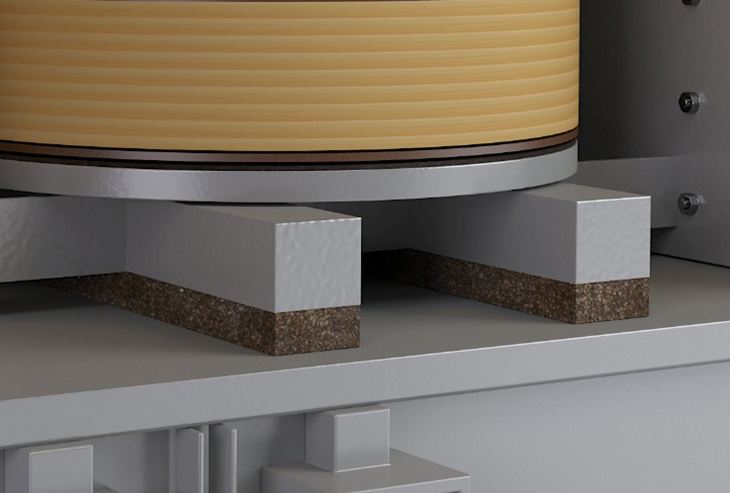
Internal Vibration Pad
The VC2100 was installed at the defined load transfer interfaces between the active part and the tank structure. By reducing the transmission of magnetostriction-induced vibrations from the core and windings to the transformer tank, the radiated noise levels were significantly decreased.
Results
Following completion of the retrofit, a new acoustic test was conducted under the same operating and measurement conditions as the original FAT.
The measured results confirmed the predictions of the engineering calculations and demonstrated a noise reduction exceeding 5 dB(A). The transformers successfully met the specified sound power and sound pressure level limits and were accepted without any additional modifications.
Long-Term Impact
The success of this project established a long-term partnership with the customer. Based on the proven effectiveness, reliability, and reproducibility of the solution, the VC2100 was subsequently specified as a standard component for all future power transformers supplied by the manufacturer.
Conclusion
This project demonstrates how advanced vibration analysis and targeted vibration isolation can effectively address transformer noise issues, even at a very late stage of production. The successful implementation of the VC2100 not only resolved a critical acceptance problem but also created lasting value for the customer by establishing a robust and repeatable noise mitigation strategy for future transformer projects.
Would you like to know more about Power Industry?
Let us know your details and we'll get back to you.