Cork continues to pave the way for new interpretations in contemporary design. CORK CROSS, an object that combines minimalist aesthetics with functionality, was recently showcased at the Lithuanian Pavilion at the 19th Venice Architecture Biennale, one of the most relevant events on the international architecture calendar.
This piece highlights how cork can take on a central role in modular, sustainable, and visually distinctive solutions.

One piece, two shapes, endless possibilities
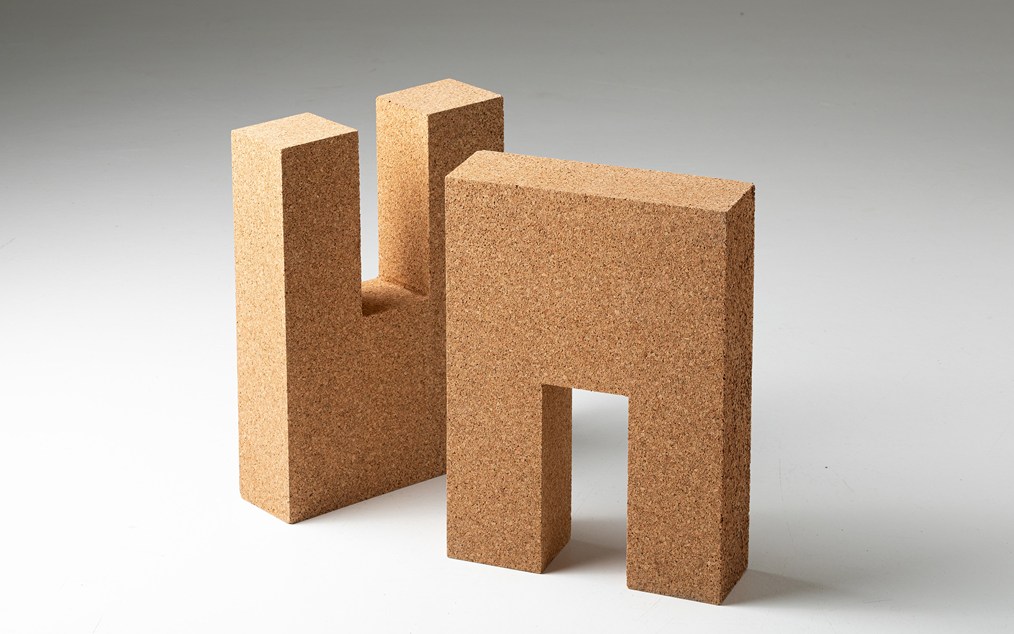
CORK CROSS is based on a simple principle: two identical pieces, each 10 cm thick, that intuitively interlock.
It requires no screws, glue, or any additional joining system. Assembly is straightforward, and the resulting structure is both solid and surprisingly lightweight.
Its geometry and the natural texture of cork give it a discreet yet striking presence: an object that balances performance, manufacturing efficiency, and a focus on sustainability.
A project developed through international collaboration
Created by designer Sandra Kasperavičienė as part of the Creative Interdisciplinary New European Bauhaus Research Centre (NEB) at the Vilnius Academy of Arts, CORK CROSS emerged from a collaborative process that brought together diverse perspectives on design, natural materials, and sustainable innovation.
The project was curated and guided by Dr. Jūratė Tutlytė, with the support of the NEB Research Centre team, and also involved Amorim, which played a key role in developing and supplying the cork used, helping explore new applications and validate the material’s behavior in this modular approach.

Prototype production was carried out by FITSOUT, completing an international partnership that enabled testing methods, refining processes, and shaping an object that blends technical rigor with aesthetic sensitivity.
In Venice: a piece designed to be used
Within the context of the exhibition “Archi / Tree / tecture”, the CORK CROSS chairs were integrated into the pavilion’s daily functioning. They served as seating for visitors and participants throughout several moments, allowing the team to test their strength and comfort in real-life situations.
This direct contact with the public opened the door to new development phases, including broader application studies and potential adaptations of the piece for different contexts, from cultural spaces to educational environments.

A project that continues to evolve
The experience at the Biennale served as a living laboratory for CORK CROSS, revealing the relevance of cork in modular design. This first prototype is just the starting point: the work now moves toward new stages of experimentation, where adaptations, formats, and use cases will be tested.
The ambition is clear: to understand how cork can play an increasingly meaningful role in functional, sustainable objects with a distinct identity.